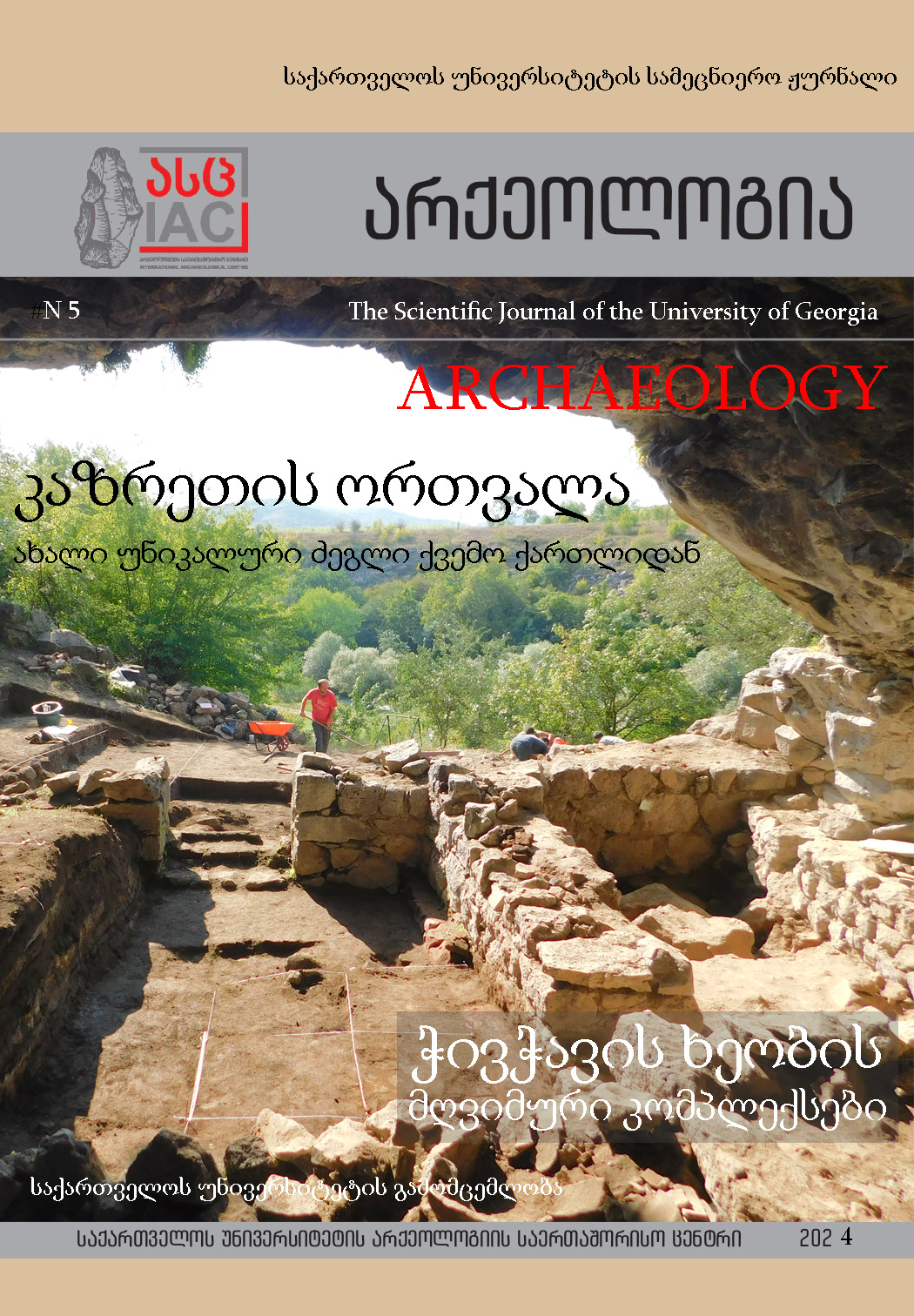
Kazreti Ortvala Cave archaeological site
Abstract
Kazreti Ortvala is a multicultural cave complex in Bolnisi Municipality, the historical Kvemo Kartli region in South Georgia (South Caucasus). The archaeological layers excavated here for the last five years indicated the wide chronological range of the site, starting from the Middle Paleolithic up to the Middle Ages. The main goal of the campaigns conducted here in 2018-2023 was to define chronological and cultural aspects, which can be listed as follows:
The first occupation of Ortvala Cave belongs to the Middle Paleolithic, presented here by Mousterian pointers produced by Early Homo Sapiens. This type of Mousterian pointers and Middle Paleolithic of the South Caucasus date back to the period between 100 000 and 40 000 BC and thus, materials of Ortvala can be associated with the same period.
The next is Mesolithic culture, represented here by obsidian and flint tools, such as scrapers, burins, perforators and Microlithes, which resemble to the known Mesolithic
materials from Georgia and are dated back by 12 000-9000 BC. It is obvious that the Mesolithic culture of Kazreti Ortvala follows the Mousterian and represents the transitional period from Old to the New Stone Age.
Obsidian and stone tools which are close to Mesolithic materials but have more progressive signs belong to a later – Neolithic period. The group of these materials include stone, obsidian and flint lamellas, burins, perforator tools, hand mill stones and also, roughly shaped pottery characterized by cylindrical forms. The next group of fragments of such a simple forms and handmade potteries, discovered on the terrace, in front of Ortvala Cave, and also on the slope heading down the river, are common for the Early Agriculture period. They are decorated with relief lines and have analogues in Arukhlo, Khramis Didi Gora materials and are dated back as 6 000 – 5 000 BC. Despite the fact that immovable layers containing cultural material of the Early Agriculture period have not been identified in Ortvala yet, we suggest, that these materials, discovered on the slope, must be washed off from the terrace located in front of the caves, where a settlement of this period could have existed.
The next phase on the site belongs to the Late Bronze – Early Iron Age. This period is represented by fragments of a black polished pottery with rich ornamental motives. The
motifs such as vertically and horizontally polished lines are common for the Late Bronze – Early Iron Age ceramics of East Georgia and they have analogous in Khovle settlement, Doghlauri cemetery, Madnistchala cemetery and others. According to parallel materials, they belong to the 12th8th centuries BC. Items characteristic for the Antique Period have not been discovered in Ortvala until recently. However, socalled “Lorica Squamata” common for 6th5th cc BC and a threewing bronze arrowhead located in the same layer nearby, were discovered on the slope in front of the Cave, during the field works in 2023. ,,Lorica Squamataʺ and three winged bronze arrow heads are common for the classical period sites of Georgia, such as Mtskheta, Vani, Sairkhe
and thus, discovery of the intact layers of this period in the future in Ortvala is quite realistic. The Early Middle Ages are well presented on the site. A cubical stone pedestal (on which the stella must have been erected) decorated with an embossed cross and the old Georgian (Asomtavruli) inscription primarily belongs to the 5th-6th cc. AD. This pedestal shows a big resemblance with the monuments of the same period from the Kvemo Kartli region. The stella itself was never discovered as a result of excavations but its fragments and embossed ornaments were revealed here in a big amount. As for the building of the Early Christian church discovered in the Northern Cave of the complex, we suggest the period between the 5th – 6th centuries AD. However, the church was destroyed and burnt down soon after its construction, in around 7th-9th centuries AD. and
the stella erected at its entrance must have been destroyed in the same period. The High Middle Ages are the stage of revival of the Early Christian church in Ortvala. During this period, the church was renovated, restored, and the floor of its interior was decorated with red tuff slabs. In the same period, significant activity was observed outside the church, on the terrace located in front of it and at the entrance of the southern cave, where household buildings and a small wine cellar were arranged. It seems that there had
been monastery life there during that period. As radiocarbon date suggests, the church and monastic complex was functioning between 1026-1160, and very soon after, as a result of JalalAdDins’ or Mongols invasions it was heavily damaged in the 13th century. The final phase of the site is represented by the late Middle Age occupations. The layer of this period has covered almost the entire perimeter of the complex and archaeological materials discovered here are presented by pottery fragments and a large number of zooarchaeological materials common for 17th-18th centuries AD of eastern Georgia.
Downloads
Published
How to Cite
Issue
Section
License
Copyright (c) 2026 დავით ბერიკაშვილი

This work is licensed under a Creative Commons Attribution 4.0 International License.
In case an article is accepted for publication it is allowed to combine the article with other researches, to conduct a new research on the article or to make different arrangements on condition that the same license is used including the commercial purpose.
As an author of an article published in Archaeology: The Scientific Journal of the University of Georgia you retain the copyright of your article and you are free to reproduce and disseminate your work.