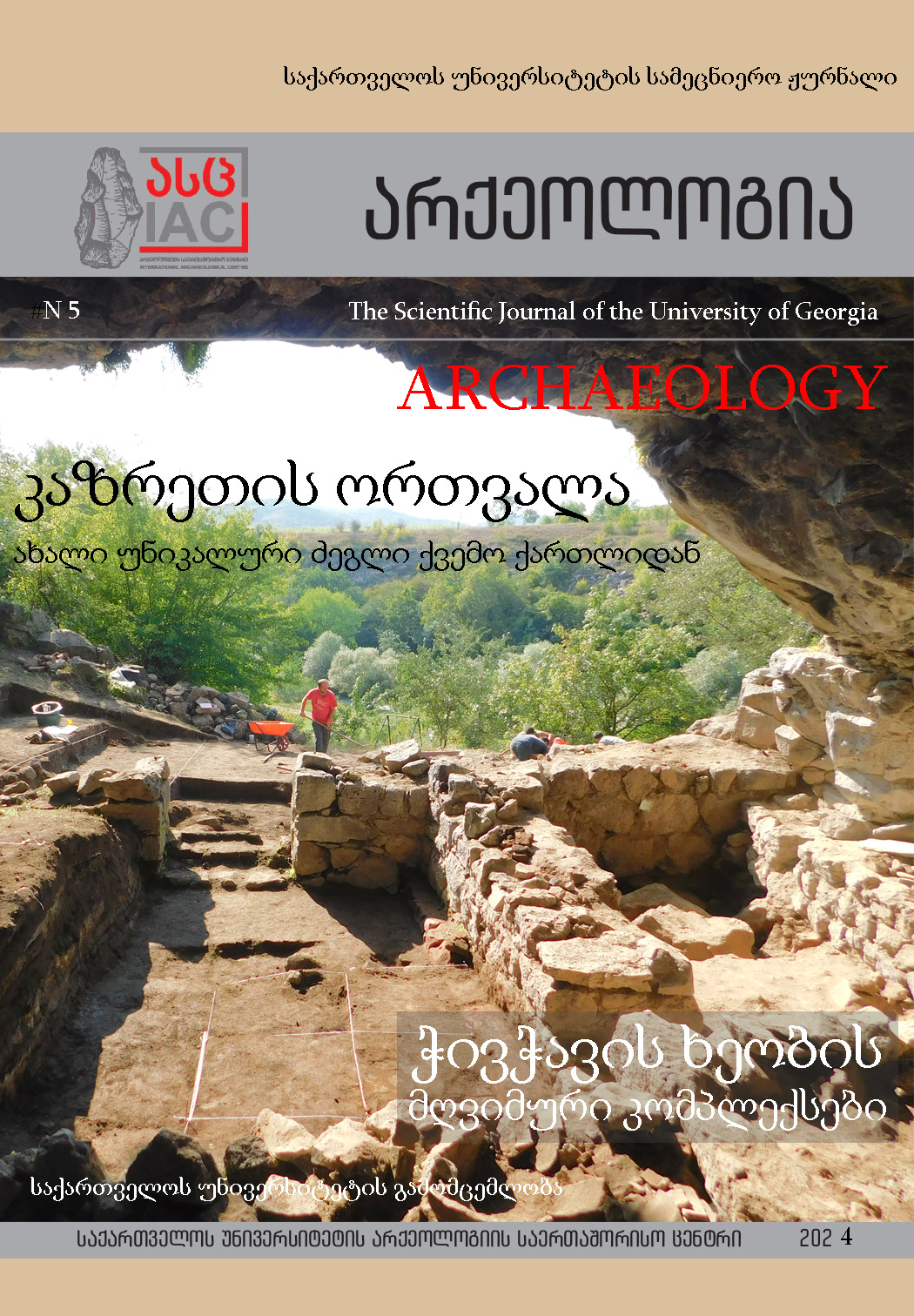
Report of reconnaissance works of the cave complexes developed on the left plateau of the Chivchavi River

Authors

  • Shota Tvaladze

Abstract

The cave complexes developed on the left side of Chivchav River are located in Kvemo Kartli, Tetritskaro district, village Southeast of Samshvilde. From the geomorpholog
ical point of view, it is built with basalt layers formed as a result of the cooling of lava flows, similar to Cape Samshvilde. Sections of these valleys are cut into lava flows, the total capacity of which is 200250m. Its middle part, where the complexes are located, is represented by dense and hidden crystalline, thick layered, massive structure lavas of dolerite and andesitebasalt composition,
which are characterized by polyhedralcolumnar separation. The opaqueness and chaos of the upper part is due to the formation of a solid crust of the lava flow. In the upper parts of the streams, these beds are predominantly spherical, while in the depths they are flattenedelon gated, which is caused by the laying of the upper masses. The thickness of the upper parts of the streams sometimes reaches several tens of meters, and its strength is significantly less
compared to the middle part.
Here, as well as on Nakalakari, basaltic rocks come to the surface of the ground and in some cases are found in the form of “hills”. Near one of these “hills” was found the unknown megalithic building Menhiri (Lat. 41.50958 Long. 44.50213), which is a vertically erected stone 1.30 meters high. It should be noted that similar megalithic monuments (two menhiris, atetralithi) are still superficially visible on Samshvilde Nakalakari, and the existence of such
a monument in their vicinity, opposite the cape, is quite natural. Northeast of the menhiri, approx. at 2.5 km, the trail descends into the Chivchavi valley and comes to a large complex of caves, which we call Chivchavi cave I complex (Lat. 41.51067Long. 44.50841). Most of the caves are inaccessible today, because there are no access paths to them due to rock erosion. Nevertheless, in 2015 it was possible to carry out reconnaissance work in 5 of them, as a
result of which about 100 ceramic fragments were found, most of which are fragments of household utensils typical of the late Middle Ages. Glazed sherds dating back to the Middle Ages were relatively small. Such an abundance of unglazed shards, characteristic of the late Middle Ages, compared to glazed ones, can be explained by the fact that they belong to the last period of human presence in these caves. The entrances of some cavescaves, which are
inaccessible without special equipment, are artificially disguised and protected by a white limestone wall.

Published

2026-02-20

How to Cite

Tvaladze, S. (2026). Report of reconnaissance works of the cave complexes developed on the left plateau of the Chivchavi River. Archaeology: The Scientific Journal of the University of Georgia, 5(5). Retrieved from https://arch.ug.edu.ge/index.php/arch/article/view/92